

A strong front door lock is an essential part of home security, but strength alone does not confirm that it meets the conditions of your home insurance policy.
When arranging or renewing cover, an insurer may ask what type of lock is fitted to your main entrance and other external doors. The answer recorded in your application may form part of the information on which your policy is based. Some policies also contain minimum-security conditions describing the locks that must be fitted and used.
There is no single lock requirement that applies to every UK property or every home insurance policy. The correct arrangement can depend on your insurer, door type, property and individual policy wording.
This guide explains how to identify common door locks, what standards such as BS3621 mean and what to do when your locks do not appear to match your insurance documents.
Key Takeaways
- Home insurance door lock requirements vary between insurers, so always check your policy schedule, statement of fact and security endorsements.
- A five-lever mortice lock does not automatically conform to BS3621, so look for the standard number and BSI Kitemark on the lock faceplate.
- Multipoint locking systems are common on uPVC and composite doors, but the entire mechanism must operate correctly and match the insurer’s description.
- French doors, patio doors, stable doors and integral garage entrances may have separate locking requirements within a policy.
- Only your insurer can confirm whether a particular lock satisfies your policy, while a locksmith can identify, repair or replace the locking arrangement.
Did you know? A lock can provide good practical security without matching the exact description recorded on your home insurance policy.
What Do Insurers Mean by Minimum-Security Requirements?

Minimum-security requirements are conditions concerning the locks and security devices protecting a property. They may appear in your policy schedule, statement of fact, endorsements or other policy documents.
An insurer may ask about the locks fitted to:
- Your main entrance door
- Back and side doors
- Wooden French doors
- Patio or sliding doors
- Doors connecting an integral garage to the home
- Other doors providing direct access to the property
- Accessible windows
The precise wording matters. A policy might ask whether your front door has a five-lever mortice deadlock, a lock conforming to a recognised British Standard or a multipoint locking system.
These descriptions are not necessarily interchangeable. A homeowner should not select the closest-sounding answer without checking the actual lock.
There is also a difference between a recommendation and a binding condition. An insurer may recommend a particular standard as good security practice, while another policy may state that a specific lock must be fitted and used whenever the property is unoccupied.
Check the following documents before making changes:
- Your latest policy schedule
- The statement of fact
- Your original application answers
- Minimum-security endorsements
- Renewal documents
- Written instructions from the insurer
Our existing guide to insurance requirements for wooden doors discusses some of the locking arrangements we commonly encounter. However, an insurer’s own documents must always take priority over general guidance.
When the wording is unclear, contact the insurer and ask for confirmation in writing.
What Is BS3621?
BS3621 is a British Standard covering thief-resistant, mechanically operated single-point lock assemblies that can be locked with a key from both sides of a door.
The standard sets performance requirements and testing methods for the complete lock assembly. Depending on the product, this can include the lock, locking plate, fixings, cylinder and protective furniture.
BS3621 is commonly associated with locks fitted to wooden external doors, including certain:
- Mortice deadlocks
- Mortice sashlocks
- Rim locks
- Night latches
Some insurers refer to BS3621 when describing the locks they expect to find on an external wooden door. This does not mean that every UK home insurance policy automatically requires it.
How can you recognise a BS3621 lock?
Open the door and inspect the metal faceplate along its edge. Depending on the lock, you may see:
- The number BS3621
- A BSI Kitemark
- The manufacturer’s name
- A model or product number
- The year or edition of the standard
A mark on the faceplate is more useful than identifying the lock by its key, handle or brand alone.
Older locks may display an earlier version of BS3621. Do not automatically assume that an older marked lock must be replaced. Show the insurer a clear photograph of the markings and ask whether it accepts the existing product.
Is a five-lever lock the same as a BS3621 lock?
Not necessarily.
The term “five lever” describes part of the lock’s internal mechanism. It does not, by itself, confirm that the complete product has been tested and certified to BS3621.
A policy might specifically request:
- A five-lever mortice deadlock
- A five-lever mortice deadlock conforming to BS3621
- A British Standard night latch
- A suitable multipoint locking system
Read the wording carefully rather than assuming that one description automatically satisfies another.
How to Identify the Lock on Your Door

You can often identify the broad type of lock without removing it or opening its internal mechanism.
Examine the edge of the door
Open the door and look at the faceplate where the latch, bolt or locking points emerge.
A short faceplate with one latch and one bolt may indicate a mortice sashlock. A lock with only a solid key-operated bolt may be a mortice deadlock.
A long metal strip running along much of the door edge usually indicates a multipoint locking mechanism.
Record any visible:
- British Standard number
- BSI Kitemark
- Manufacturer
- Model number
- Certification symbol
Take clear photographs. These can help a locksmith identify the product and allow your insurer to comment on the precise arrangement.
Mortice deadlocks
A mortice deadlock is fitted into a pocket cut within the door. Turning the key throws a solid bolt into a keep in the frame.
A deadlock does not normally operate the door handle or latch. It may be fitted as the only lock or used alongside a separate night latch.
Mortice deadlocks are frequently found on traditional wooden front and back doors.
Mortice sashlocks
A mortice sashlock combines two functions:
- A latch operated by the handles
- A deadbolt operated by a key
The latch holds the door closed during normal use, while the deadbolt provides additional locking when the key is turned.
Night latches
A night latch is usually mounted on the internal face of the door. Closing the door causes the latch to engage automatically.
Basic night latches and higher-security British Standard night latches should not be treated as identical products. Check the body, faceplate and accompanying markings before describing the lock to your insurer.
Multipoint locking systems
A multipoint mechanism secures a door at several positions along its frame.
Depending on the design, it may include:
- Hooks
- Rollers
- Bolts
- Mushrooms
- A central latch
- A central deadbolt
Many systems are operated by lifting the handle and then turning the key. The handle movement engages the locking points, while the key secures the mechanism.
Multipoint locks are common on uPVC and composite doors, although they can also be fitted to other door types.
Door-Lock Considerations for Different Types of Door
Insurance questions frequently distinguish between wooden, uPVC, composite, French and patio doors. Identifying both the door material and the locking arrangement will help you provide an accurate answer.
Wooden external doors
Wooden entrance doors can use several types of lock, including:
- Mortice deadlocks
- Mortice sashlocks
- Night latches
- Multipoint mechanisms
Your policy may refer to a five-lever lock, BS3621 certification or another suitable arrangement.
The lock is only one part of the door’s overall security. A high-quality lock cannot correct serious weaknesses in a damaged door or frame.
Check for:
- Split or decayed timber
- Movement in the frame
- Loose hinges
- Damaged keeps
- Poorly aligned bolts
- Signs of previous forced entry
- Excessive gaps around the door
The deadbolt should enter its keep correctly and to its intended depth. A loose or badly positioned keep can reduce the effectiveness of the locking system.
uPVC doors
Most modern uPVC doors use a multipoint mechanism operated through the handles and a key cylinder.
The complete system normally includes:
| Component | Purpose |
| Multipoint mechanism | Moves the hooks, rollers or bolts |
| Gearbox | Transfers movement from the handle and key |
| Cylinder | Accepts the key and secures the mechanism |
| Handles | Operate the latch and locking points |
| Keeps | Receive the locking points in the frame |
| Hinges | Hold the door in the correct position |
The presence of several locking points does not automatically confirm that the arrangement matches your insurer’s wording. The condition, operation and security of the complete system should also be considered.
Warning signs of a developing uPVC door problem include:
- A handle that is difficult to lift
- A key that sticks or becomes difficult to turn
- A door that must be pushed or pulled before it locks
- Hooks that do not align with their keeps
- A door that has dropped on its hinges
- Loose or damaged handles
- A damaged or projecting cylinder
These symptoms can indicate misalignment, wear or an internal mechanism problem. Continuing to force the handle or key may make the fault worse.
Our uPVC door and window repairs service covers locking mechanisms, handles, hinges and related adjustment work.
Composite doors
Composite doors commonly use a multipoint mechanism with a euro-profile cylinder.
Check that:
- Every locking point engages
- The handle lifts smoothly
- The key turns without excessive resistance
- The cylinder is secure
- The handles are not loose
- The keeps remain firmly attached
- The door closes without force
Do not assume that a composite door automatically meets an insurance condition simply because it is relatively new or has several locking points.
The insurer may ask for a specific type of multipoint system or cylinder security level. Provide photographs and product details when you are uncertain.
Wooden French doors and double doors
French doors require particular attention because the two leaves interact.
One leaf is usually treated as the active door. The other is secured in place before the active leaf is closed and locked.
Depending on the doors and policy, the arrangement may include:
- A rebated mortice lock
- A multipoint locking mechanism
- Key-operated bolts
- Mortice rack bolts
- Top and bottom bolts
- Additional reinforcement
In our experience, insurers can request key-operated bolts on the fixed leaf of wooden French doors. Some may impose additional requirements affecting both leaves.
Do not assume that ordinary surface bolts are sufficient. Ask the insurer to describe what it accepts and whether the bolts must be key operated.
Patio and sliding doors
Patio doors may be covered by a separate question on the insurance application.
Common security arrangements include:
- Multipoint locks
- Hook bolts
- Key-operated locks
- Anti-lift devices
- Additional patio door locks
Sliding doors must remain properly aligned so that the hooks or bolts engage correctly. Check that the door cannot be lifted or moved excessively within its frame when locked.
Use the insurer’s exact terminology when describing the system. If none of the available application answers seem accurate, contact the insurer rather than selecting an unsuitable option.
Stable doors
A stable door is divided into upper and lower sections that can move independently.
An insurer may consider each section as a separate opening and may expect both halves to have an appropriate locking arrangement. The requirements can vary, so ask whether each section needs its own lock or security device.
Integral garage access
A door between an integral garage and the living accommodation can provide access to the home. It may therefore be relevant to the insurer’s security conditions.
Check:
- The external personnel door into the garage
- The connecting door between the garage and house
- Any side or rear garage entrance
- The main garage door locking arrangement
Do not limit your review to the property’s main front door.
Home Insurance Door-Lock Checklist
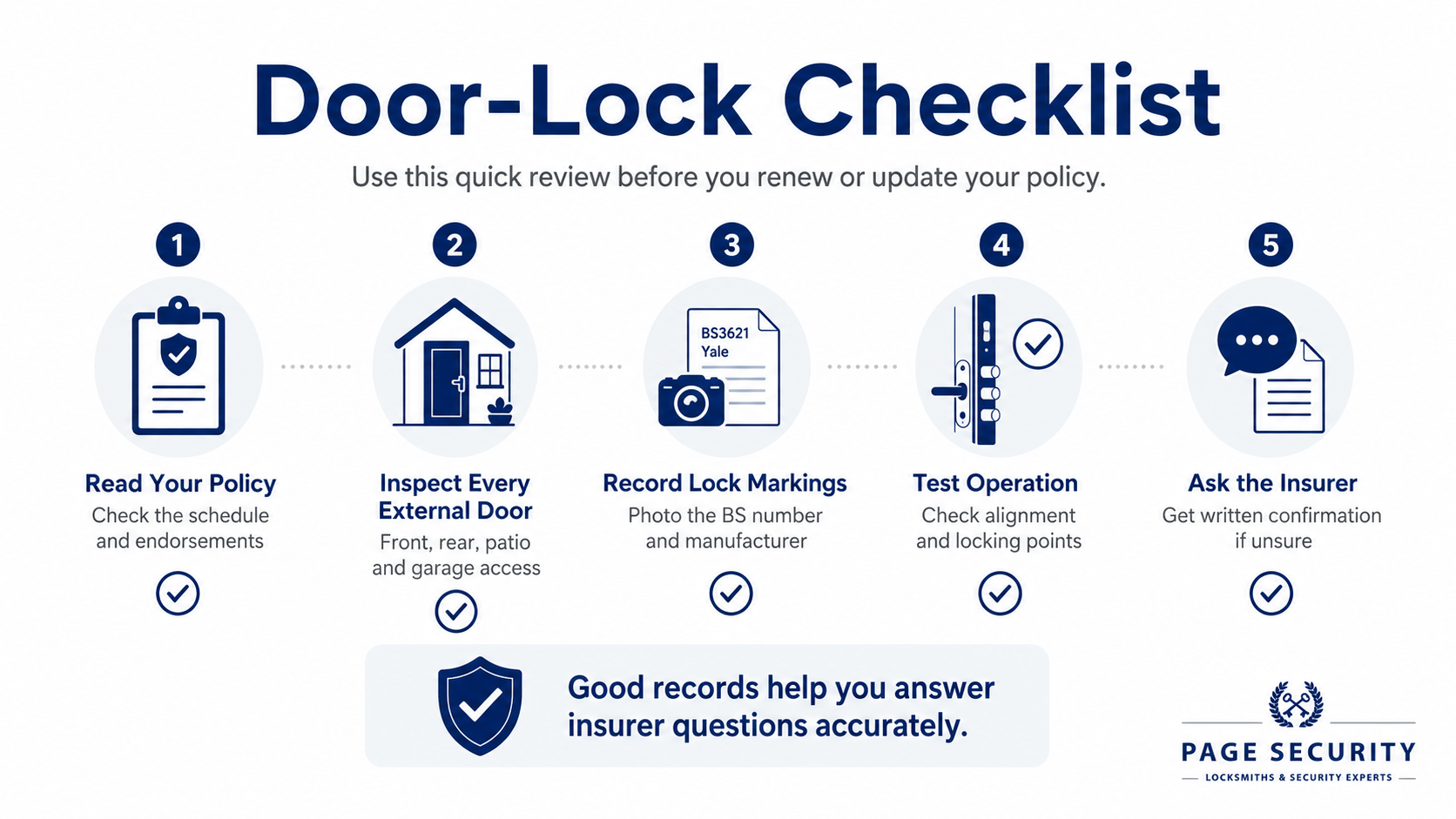
Use this checklist when applying for insurance, renewing a policy or reviewing your home security.
| Check | What to confirm |
| Policy wording | Read the schedule, statement of fact and endorsements |
| Main entrance | Record the door material and exact lock type |
| Other external doors | Include rear, side, patio, French and garage doors |
| Lock markings | Photograph BS numbers, Kitemarks and manufacturer details |
| Multipoint systems | Confirm that every locking point engages |
| Cylinders | Check for looseness, damage or excessive projection |
| Door alignment | Make sure the door locks without unusual force |
| Frame and keeps | Look for movement, decay, cracks or loose fixings |
| Keys | Consider whether any keys are missing or unaccounted for |
| Evidence | Retain photographs, invoices and product information |
| Insurer response | Keep written confirmation of any advice |
Questions to ask your insurer
When a requirement is unclear, ask specific questions:
- Does my policy require a particular British Standard?
- Does the condition apply to every external door?
- Is my existing multipoint mechanism acceptable?
- Are key-operated bolts required on my French doors?
- Does the door from my garage into the house have a separate requirement?
- Must every specified lock be used whenever the property is unoccupied?
- Should I notify you after changing a door, lock or cylinder?
- Can you confirm your answer in writing?
Keep the insurer’s response with your policy documents.
What If Your Locks Do Not Match the Policy Description?
Do not ignore a discrepancy between your locks and the information recorded by your insurer.
The effect will depend on the policy wording, the answers supplied during the application, any minimum-security endorsement and the circumstances of a future claim. It is not possible to state that every mismatch will produce the same outcome.
Take the following steps:
- Read the current policy documents.
- Identify and photograph the existing locks.
- Contact the insurer.
- Explain the arrangement accurately.
- Ask whether an upgrade is necessary.
- Request confirmation in writing.
- Keep records of any repair or replacement work.
Avoid relying on the general phrase “insurance approved”. A lock may meet a recognised standard without necessarily matching every condition imposed by every insurer.
Equally, an insurer may accept a secure arrangement without using that phrase at all.
Only your insurer can confirm whether a particular door and lock arrangement satisfies your individual policy.
What Should You Do After a Break-In?
The safety of the occupants comes first. Contact the police where appropriate and avoid disturbing potential evidence unnecessarily.
You should then:
- Notify your insurer promptly.
- Photograph damage to the doors, locks, windows and frames.
- Make a list of damaged or missing property.
- Arrange temporary security if the building cannot be locked.
- Ask whether the insurer must approve permanent repairs.
- Retain invoices and details of replacement products.
- Keep the police crime reference number and related correspondence.
A forced door may need more than a new lock. The door leaf, frame, hinges, keeps and surrounding structure should all be inspected for damage.
Our burglary repairs service can assist with emergency security work, damaged locks, doors and frames following a break-in.
When Should a Door Lock Be Repaired or Replaced?

Arrange an inspection when:
- The lock does not match a stated policy requirement
- You cannot identify the lock
- A key has been lost or stolen
- The property has recently changed ownership or occupancy
- The lock is damaged or unreliable
- The key or handle has become stiff
- The door no longer aligns with its frame
- The locking points do not engage
- The door has been forced or attacked
- You do not know who may still hold copies of the keys
A locksmith can assess the complete arrangement rather than looking only at the visible lock.
This can include:
- Door construction and thickness
- Lock type and condition
- Frame strength
- Hinge condition
- Bolt and keep alignment
- Multipoint mechanism operation
- Cylinder and handle security
- Appropriate repair or replacement options
Our lock replacement and lock repairs service can help when a lock is worn, damaged, difficult to operate or needs upgrading.
A locksmith can identify products and explain suitable security options. The final decision about whether an arrangement meets the conditions of a particular insurance policy remains with the insurer.
Frequently Asked Questions
Do all home insurers require BS3621 locks?
No. BS3621 is commonly mentioned in connection with external wooden doors, but requirements vary between policies and insurers. Check your own policy documents.
Is every five-lever lock a BS3621 lock?
No. The number of levers does not, on its own, prove that the complete lock assembly conforms to BS3621. Look for the standard number and certification markings.
Are multipoint locks accepted by home insurers?
They may be accepted, particularly on uPVC and composite doors, but the answer depends on the individual policy and the insurer’s description of the required system.
Does a BSI Kitemark guarantee that my insurance is valid?
No. A Kitemark helps identify a certified product. It does not confirm that every condition of your insurance policy has been met.
Will an insurer automatically reject a claim if the wrong lock is fitted?
Not necessarily. The outcome depends on the policy terms, the information given to the insurer and the circumstances of the claim.
Can a locksmith confirm that my insurance is valid?
A locksmith can identify your locks, assess their condition and fit suitable products. Only the insurer can confirm that an arrangement meets its policy requirements.
Check Both the Lock and the Policy
A secure-looking door should not be assumed to match an insurance description.
Identify the locks fitted to every external entrance, photograph their markings and compare them with your latest policy documents. Pay particular attention to wooden doors, French doors, patio doors, uPVC multipoint systems and doors providing access from an integral garage.
Where the wording is unclear, ask the insurer to confirm its requirements in writing. Repair stiff, damaged or poorly aligned doors before the problem develops into a complete failure.
For assistance identifying, repairing or replacing a lock, contact Page Security. We can assess the door and locking arrangement, explain the available options and carry out appropriate security work.
Further Reading
- BS 3621:2017+A1:2024, Lock Assemblies Operated by Key from Both Sides: The official BSI overview of the current BS3621 standard, including its scope, performance requirements and application to thief-resistant single-point lock assemblies.
- Door and Window Lock Advice: Practical guidance from Police.uk on choosing secure locks for doors and windows, including advice concerning euro cylinders and recognised security standards.
- What to Consider When Renewing Your Insurance Policy: Guidance from the Association of British Insurers on checking policy changes, excesses and minimum-security requirements when renewing insurance.
- What Is Home Insurance?: An independent MoneyHelper guide explaining home insurance, the types of cover available and how security measures such as BSI-approved locks may be relevant.
- Making a Home Insurance Claim: Advice from the Association of British Insurers on contacting an insurer, documenting damage and handling emergency repairs when making a claim.
