

Living in a London flat means thinking about security at more than one doorway. Your own front door is the final barrier to your home, while the communal entrance controls who can reach shared corridors, stairwells and individual flats.
At Page Security, we work on locks, door entry systems, access control and door closers. For flats and apartment blocks, a layered approach makes sense. A strong flat entrance matters, but so does a communal entrance that closes and locks reliably.
The right solution depends on the building, door type, existing hardware and any fire safety or management requirements.
In many cases, the most useful first step is simply identifying which part of the entrance is failing, rather than assuming that the lock itself is always the cause.
Key Takeaways
- Flat security should consider both your individual front door and the building's communal entrance.
- A reliable lock depends on the condition and alignment of the door, frame, hinges and keeps.
- Communal doors should close and secure correctly, while faulty closers, locks and entry systems should be reported promptly.
- Door entry and access control systems can help manage who enters shared areas of a block of flats.
- Fire doors and self-closing devices must not be altered or obstructed in ways that could affect the building's fire safety arrangements.
Did you know? In blocks where the top storey is more than 11 metres above ground level, communal fire doors require checks at least every three months. Have you checked how well your building's communal entrance closes and secures?
Why flats need security at both entrances

The first layer is the communal entrance. It may use a conventional lock, electric release, door entry system, keypad, proximity reader or another form of access control. Its role is to manage access to shared areas.
The second is your individual flat entrance door. This protects the home if somebody gains access to the building.
When reviewing security, look beyond the lock. The door, frame, keeps, hinges, alignment and locking mechanism all matter. If a door must be lifted, pulled or slammed before the lock works, the underlying fault should be investigated.
For more practical ideas, see our guide to improving home security in London without major renovations.
How to improve your flat front door security
Check the whole door before changing the lock
A lock works properly only when the door and frame allow it to engage as intended. Before replacing a lock, check whether the problem could involve alignment, hinges, the keep, the frame or the mechanism.
Warning signs include:
- A key that has become stiff or difficult to turn
- A door that no longer closes squarely
- A lock that works only when the door is pushed or pulled
- Loose handles or hinges
- Visible damage to the frame or keep
- Damage following an attempted break-in
Some faults can be adjusted or repaired without replacing the whole door. Others may require a new lock, cylinder or mechanism. Our Lock Replacement and Lock Repairs London service covers a wide range of faults and replacement requirements.
Match the lock to the door type
Timber doors
Timber doors may use a night latch, mortice deadlock or a combination of locks. A night latch uses a spring latch and can latch automatically when the door closes. A mortice deadlock uses a solid bolt and is normally locked deliberately with a key.
A basic night latch should not automatically be assumed to provide enough protection as the only lock on an external door. On a suitable timber door, a mortice deadlock may provide another locking point.
Insurance wording varies. Some policies refer to British Standard locks, so check what your insurer actually requires rather than assuming the same standard applies everywhere.
Our guides to night latches and deadlocks and insurance requirements for wooden doors explain these issues in more detail.
uPVC and composite doors
uPVC and composite doors commonly use multipoint locking systems. Components can include the cylinder, gearbox, locking strip, hooks, rollers, bolts, handles and keeps.
If the door becomes difficult to lock, forcing the handle is not a good long-term solution. Alignment or mechanism faults can worsen, and adding a traditional timber-door lock is not usually the answer.
Check whether the flat entrance is a fire door
In blocks of flats, the entrance to an individual flat may be a fire-resisting door that forms part of the building's fire safety arrangements. Government guidance stresses that relevant flat entrance fire doors should be kept in good repair and that self-closing devices must work effectively where required.
If you want to alter or replace a flat entrance fire door, government guidance says this should be done with the knowledge and agreement of the Responsible Person so the building's fire risk assessment is not negatively affected.
If you are unsure whether your entrance is a fire door, speak to the building manager, freeholder or other Responsible Person before making significant changes.
How to improve communal entrance security
If the communal entrance does not close and secure reliably, an important layer of protection is weakened.
Make sure the door closes properly
Where a door closer is fitted, it should return the door to the closed position so the locking arrangement can engage.
Problems worth reporting include:
- The door stopping before it reaches the frame
- The latch or electric release failing to engage
- A door that needs to be slammed
- A closer that works inconsistently
- Damage to the frame, hinges or locking hardware
Page Security provides Door Closer Installation and related door closer services.
Check the locking arrangement
Communal doors have to balance security, normal access and safe escape. The correct arrangement depends on the building, door, entry method and applicable fire safety requirements.
An entry panel or fob reader cannot compensate for a door that can be pushed open because its locking hardware does not engage. Equally, additional locks should not be fitted without considering safe escape.
Our guide to locks for communal doors explains some of the issues found at shared entrances.
Do not prop open fire doors
Where communal doors or flat entrance doors are fire doors, keeping them closed is part of their function. London Fire Brigade advises that front doors and doors on communal hallways or landings should be maintained as self-closing fire doors and must not be left propped open.
Government guidance also tells residents not to tamper with self-closing devices and to report faults to the Responsible Person.
Door entry and access control for blocks of flats
Door entry and access control can help manage access to shared buildings, but they perform different functions.
Door entry systems
A door entry system normally allows a resident or authorised person to communicate with a visitor before releasing the entrance. Depending on the installation, options can include:
- Audio entry
- Video entry
- GSM entry
- Keypad access
- Proximity cards or fobs
- Wired or wireless equipment
Video entry can allow residents to see and speak to visitors, while GSM systems can route visitor calls to nominated mobile or landline numbers.
Page Security installs, repairs and maintains Door Entry Systems for homes, flats and commercial properties.
Access control
Access control determines whether a person has authorised access, often through a card, fob, tag or code.
Depending on the equipment, programmable systems may allow credentials to be added or removed without changing a mechanical lock. Some systems also provide audit or remote management features. Functions vary, so they should be checked against the installed equipment.
Page Security provides Access Control Installation for residential and commercial entrances.
Fire door responsibilities at a glance
The table below summarises key points from current Fire Safety (England) Regulations guidance for multi-occupied residential buildings in England.
| Building or door | Current guidance |
|---|---|
| Multi-occupied residential buildings with two or more domestic premises and common parts | Residents should receive information about the importance of fire doors, including keeping them shut when not in use, not tampering with self-closing devices and reporting faults |
| Buildings where the top storey is more than 11 metres above ground level | The Responsible Person must use best endeavours to check flat entrance fire doors at least every 12 months |
| Fire doors in communal areas of buildings where the top storey is more than 11 metres above ground level | Checks are required at least every three months |
These requirements do not mean every communal entrance is automatically a fire door. The fire risk assessment and Responsible Person should identify the relevant doors and arrangements.
Everyday security habits for flat residents
Useful routines include:
- Lock your flat door properly when you leave
- Keep keys away from exterior doors and letterboxes
- Report lost communal access cards or fobs promptly
- Do not casually admit people you do not know into the building
- Report a communal door that no longer closes or locks reliably
- Report faulty intercoms, keypads, fob readers or electric releases
- Do not prop open doors that are required to remain closed
- Report faults with fire doors and self-closing devices
- Deal with stiff, damaged or unreliable locks before they fail completely
The Metropolitan Police also advises keeping keys away from exterior doors and using locks properly when leaving home.
An intruder alarm can add another security layer, but it should complement secure doors and controlled access rather than replace them. Page Security provides Burglar Alarms for domestic and commercial properties.
Tenants, leaseholders, landlords and managing agents
Responsibility for a door or security system depends on the property, tenancy or lease and building management arrangements.
Tenants should report defective communal doors, entry systems and relevant fire-door problems to the landlord or managing agent. Leaseholders should check their lease and speak to the Responsible Person before making changes to a flat entrance door where fire safety arrangements may be affected.
For fire safety, the Responsible Person may be the building owner, freeholder or another person who has control of the premises, such as a managing agent.
In blocks where the top storey is more than 11 metres above ground level, current regulations require best-endeavours annual checks of flat entrance fire doors and checks of communal fire doors at least every three months.
This is general information rather than legal or fire safety advice. Building-specific requirements should be checked with the appropriate Responsible Person and, where necessary, a competent fire safety professional.
When should you call a locksmith or security specialist?
Consider professional help if:
- Your flat door no longer closes or locks smoothly
- A key, cylinder, handle or mechanism is becoming unreliable
- The door or frame has been damaged
- Keys have been lost or stolen
- The communal entrance does not close and secure reliably
- An electric release, keypad, fob reader or intercom has developed a fault
- A door closer is no longer operating correctly
- You are unsure whether the existing locking arrangement is suitable
A proper assessment should consider the door, frame, lock and associated hardware rather than treating every fault as a simple lock replacement.
Flat and apartment security checklist
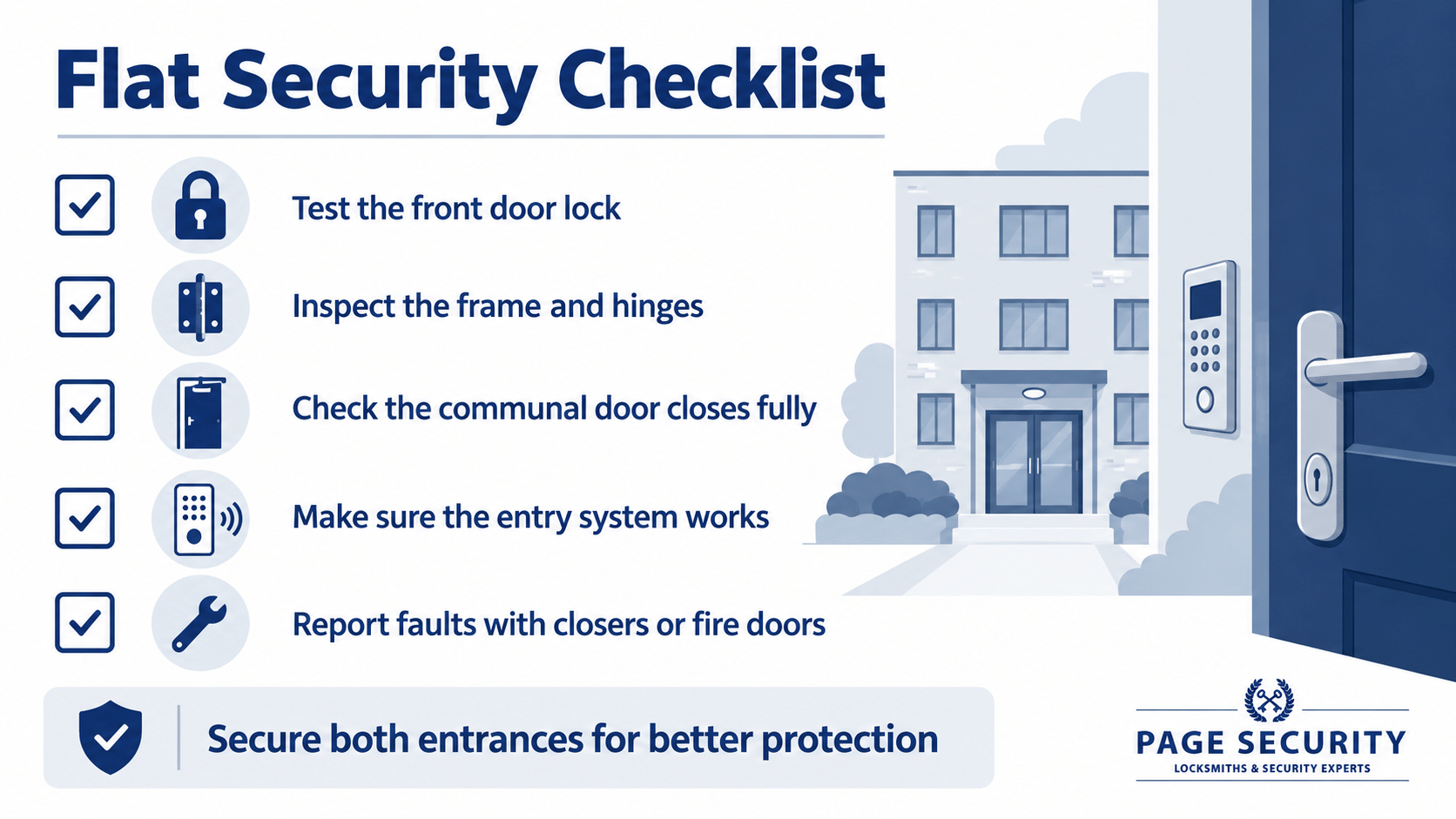
Use this quick check to review the two main layers of security around your home:
- Does your flat entrance door close squarely into the frame?
- Do the locks operate smoothly without forcing them?
- Are the frame, hinges and keeps secure and undamaged?
- Does the communal entrance return to the closed position after use?
- Does its locking arrangement engage reliably?
- Does the door entry system work correctly?
- Have lost keys, cards or fobs been reported?
- Are keys kept away from the front door and letterbox?
- Are relevant fire doors being kept closed and faults reported?
- Have stiff or unreliable locks been checked before they fail?
Secure the flat and the building entrance
Security in a London flat should not stop at the individual front door. The strongest approach considers the flat entrance and communal entrance as separate but connected layers.
A sound door and frame, suitable locks, a communal entrance that closes reliably, and properly maintained door entry or access control can all contribute to better security. Where fire doors or shared escape routes are involved, any changes also need to respect the building's fire safety arrangements.
At Page Security, we help with lock repairs and replacements, door closers, door entry systems, access control and burglar alarms. If you have a problem with your flat entrance or communal door, contact us to discuss the most appropriate next step.
