

Summer can be one of the busiest times of year for holiday lets, Airbnb properties and short-term rentals. More bookings mean more guest arrivals, more changeovers, more key handovers and more pressure on the locks, doors, alarms and access systems that keep the property secure.
For landlords and hosts, good security is not only about preventing a break-in. It is also about helping guests feel safe, avoiding avoidable lockouts, managing cleaners and contractors, protecting vacant periods between bookings and keeping control of who can access the property.
At Page Security, we help property owners with practical locksmith and security services, including lock replacement and lock repairs, Upvc door and window problems, burglary repairs, alarm systems, access control systems and door entry systems. If you manage a holiday let or Airbnb property, summer is a sensible time to check that your security is still working as it should.
Key Takeaways
- Holiday let security should cover more than burglary prevention, including guest access, lost keys, lockouts, cleaners, contractors and vacant periods between bookings.
- Locks, doors, frames, Upvc doors, patio doors and bifold doors should be checked before the busiest summer weeks.
- Key safes and smart locks can make guest access easier, but they need to be managed carefully and reviewed regularly.
- App-monitored alarms and access control systems can help landlords manage properties remotely and protect areas guests should not enter.
- A simple changeover checklist can help cleaners spot stiff locks, unsecured windows, faulty doors and missing keys before they become bigger problems.
Did you know? A holiday let may be accessed by guests, cleaners, contractors and property managers in the same week, which makes clear access control essential.
Why holiday lets need a different approach to security
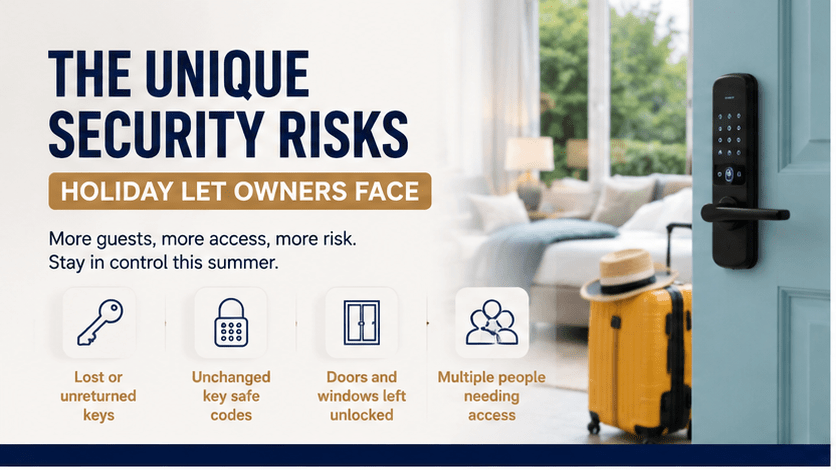
A private home may have the same people using the same keys every day. A holiday let is different. Guests arrive and leave regularly. Cleaners may need access between stays. Maintenance teams may attend at short notice. Friends of guests may be given details without the owner knowing.
This creates a different set of risks. Even when guests are careful and respectful, they may not know the property well. They may forget to lock a rear door, leave a window open, misplace a key or share a code with someone else in the group.
Holiday let security should therefore focus on three things:
- Controlled access: knowing who can enter the property and when
- Reliable physical security: making sure doors, frames, windows and locks work properly
- Simple routines: giving guests and cleaners clear steps to follow
The aim is not to make the property feel difficult to use. A secure holiday let should still be convenient for guests. The best security arrangements are simple, reliable and easy to manage between bookings.
Common security risks for landlords and Airbnb hosts
Holiday let owners should pay particular attention to access control because the property may be used by many people over a short period. The more people who have keys, codes or entry instructions, the harder it becomes to keep control.
Common risks include:
- Guests losing keys during their stay
- Keys not being returned at checkout
- Spare keys being left in obvious places
- Key safe codes not being changed regularly
- Guests sharing access details with other people
- Cleaners or contractors keeping old keys
- Patio doors and rear doors being left unlocked
- Ground floor windows being left open
- Communal entrance doors being propped open
- The alarm not being set after checkout
- Locks becoming stiff or unreliable during a busy period
Small issues can quickly become bigger problems. A stiff lock can turn into a failed lock. A poorly aligned Upvc door can become difficult for guests to secure. A missing key can create uncertainty about who may still have access to the property.
That is why landlords and hosts should treat security as part of the changeover process, not just something to think about after a problem.
Holiday let security risk table
The table below shows common risks and the security measures that can help reduce them.
| Security risk | Why it matters | Practical action |
| Lost guest keys | Someone else may find or keep access to the property | Consider rekeying or lock replacement if the key cannot be accounted for |
| Old key safe code | Previous guests or contractors may still know the code | Change codes regularly and after any concern |
| Stiff door lock | Guests may be unable to lock or unlock the property | Arrange professional lock repair before the lock fails |
| Misaligned Upvc door | The multipoint lock may not engage correctly | Check the door, frame and locking mechanism |
| Patio door not locking | Rear access points can be overlooked | Repair or replace faulty patio door locks |
| Alarm not set | The property may be unprotected between bookings | Use clear checkout instructions and consider app monitoring |
| Communal door left open | Shared areas become less secure | Review door entry and access control options |
| Break-in damage | Doors, frames and locks may be compromised | Arrange burglary repairs and secure the property quickly |
Start with a full lock and entry point review

The first step is to check every way into the property. Many owners focus on the front door, but guests may use rear doors, patio doors, side gates, garages and garden access just as often during the summer.
Check the following areas:
- Front door
- Back door
- Patio door
- Bifold door
- Upvc door
- Side gate
- Garage door
- Shed or outbuilding
- Ground floor windows
- Balcony doors
- Communal entrance doors
- Internal locked storage areas
A good lock should operate smoothly. The key should turn without force, the handle should feel secure and the door should close cleanly into the frame. If a guest has to lift, push, pull or slam the door to make it lock, the problem should be checked.
Warning signs that a lock or door needs attention
Look out for:
- A key that sticks or catches
- A loose handle
- A lock that feels stiff
- A door that catches on the frame
- A Upvc door that only locks when lifted
- A multipoint lock that does not engage properly
- A key that spins without operating the lock
- A patio door that will not close neatly
- A door frame that looks damaged or loose
These problems are especially important in a holiday let because guests may not know how to work around them. What feels like a minor issue to the owner can become a failed check-in, an emergency callout or a security risk.
For further guidance, read our guides on Upvc door lock problems and patio door lock problems. If the property has folding doors, our bifold door repairs service may also be relevant.
Rekey, replace or upgrade locks between guest cycles?
Landlords and hosts do not need to replace every lock after every booking, but they should have a clear process for dealing with missing keys or uncertain access.
A lock review is sensible when:
- A guest loses a key
- A guest does not return a key
- A cleaner, contractor or property manager no longer works with you
- The property has recently changed ownership
- You do not know how many key copies exist
- A lock is old, stiff or unreliable
- There has been a break-in or attempted break-in
- You want to improve the security level of the door
Rekeying
Rekeying changes the internal pins or mechanism so that old keys no longer operate the lock. This may be suitable if the existing lock is in good condition and the main concern is key control.
Lock replacement
Lock replacement may be better if the lock is damaged, worn, outdated or not suitable for the property. It can also be a good option after a lost key incident if you want complete peace of mind.
Lock upgrade
An upgrade may be appropriate if you want better security, improved usability or a more suitable lock for a rental property. The right choice depends on the door type, frame condition and how the property is managed.
For more detail, see our guide: Lock Rekeying Service vs. Replacement: Which Is Right for You?
Are smart locks a good idea for Airbnb and holiday lets?

Smart locks can be useful for short-term rental properties because they reduce reliance on physical key handovers. For some hosts, the ability to change access codes between bookings is a major advantage.
Potential benefits include:
- No need for guests to collect physical keys
- Codes can be changed between stays
- Temporary access can be given to cleaners or contractors
- Some systems may provide entry records
- Guests can check in without meeting the host
- Remote management may be easier for landlords who live away from the property
However, smart locks are not suitable for every property or every door. They need to be installed correctly, maintained properly and explained clearly to guests. Batteries need checking, app access should be managed carefully and any insurance requirements should be reviewed.
Most importantly, the physical security of the door still matters. A smart lock fitted to a weak, damaged or poorly aligned door will not solve the underlying problem. The door, frame, cylinder and locking mechanism should all be suitable.
For a balanced comparison, read our guide: Smart Lock vs Traditional Lock: Which Is Best for Your Property?
Key safes: convenient, but only when used properly
Key safes are common in holiday lets because they make check-in easier. They can be useful, but they must be managed carefully. A weak key safe, a poor location or an unchanged code can become a security weakness.
Key safe best practice
Landlords and hosts should:
- Choose a robust, high-quality key safe
- Avoid obvious hiding places
- Avoid placing the key safe too close to the front door if possible
- Change the code regularly
- Change the code after any concern or lost key incident
- Avoid simple codes such as 1234 or the property number
- Share the code close to check-in rather than far in advance
- Remove old access details from guest instructions
- Never leave spare keys under mats, plant pots or bins
A key safe should be part of a wider security plan, not the only security measure. If the same code has been shared with many guests or contractors, it may be time to review the property’s access arrangements.
App-monitored alarms for remote landlords
Many holiday let owners do not live near the property. An app-monitored alarm system can help owners keep better control when the property is empty, when guests check out or when cleaners need access.
Depending on the system, app monitoring may allow:
- Remote arming and disarming
- Real-time alerts
- Event history
- Fault notifications
- Door and window contacts
- Motion detectors
- Zone control
- Alerts relating to power or battery issues
This can be helpful during vacant periods between bookings. For example, if a guest forgets to set the alarm after leaving, remote access may help the owner or manager take action. If a cleaner needs to enter, the system may be managed without handing out long-term access details.
Alarm systems can also help protect areas that guests should not enter, such as owner storage, garages, offices or plant rooms. The right system depends on the property layout, the number of users and the level of control required.
Page Security offers burglar alarms and has written further guidance on alarm systems with app monitoring.
Access control and door entry for flats and shared buildings
Many Airbnb and holiday let properties are flats, maisonettes, converted buildings or serviced accommodation units. In these settings, the front door of the individual property is only one part of the security picture.
Landlords may also need to think about:
- Communal entrance doors
- Fob or keypad access
- Door entry systems
- Audio or video entry
- Access for cleaners and maintenance teams
- Access permissions for property managers
- Preventing guests from wedging communal doors open
- Clear instructions for shared entrances
A secure flat can still be at risk if the communal entrance is not managed properly. Guests should understand how to use the entry system and why shared doors must not be left open.
For larger holiday properties, serviced accommodation and mixed-use buildings, access control can help manage who enters different parts of the building. It may also reduce the need for multiple physical keys.
Page Security provides access control installation, door entry systems and Paxton access products, installation and servicing.
Do not forget patio doors, rear doors and outdoor spaces
Summer guests are more likely to use gardens, terraces, balconies and outdoor areas. This means rear doors, patio doors, bifold doors, sheds and side gates need proper attention.
A well-secured front door is important, but it is not enough if the rear of the property is weak. Burglars may look for less visible entry points, especially where gardens or side paths provide cover.
Check:
- Patio doors open and lock properly
- Bifold doors align and close correctly
- Side gates can be locked
- Garage doors are secure
- Sheds and outbuildings have suitable locks
- Garden tools and ladders are not left accessible
- External lighting works
- Balcony doors and windows lock properly
- Guests know which doors must be locked before leaving
Outdoor storage is also worth checking. Bikes, garden equipment, tools and maintenance items should not be left unsecured. Tools can be stolen, but they can also be used to force entry.
Our summer home security checklist gives further practical advice for protecting property during the warmer months.
Create a security checklist for cleaners and changeovers
Cleaners and changeover staff often have the final opportunity to check the property before the next guest arrives. A simple checklist can reduce mistakes and help identify problems early.
Changeover security checklist
Ask cleaners or property managers to check:
- All windows are closed and locked
- The front door closes and locks properly
- Patio doors and rear doors are secure
- Bifold doors are aligned and locked
- Keys have been returned or stored correctly
- The key safe code has been changed if required
- No guest keys have been left inside the property
- The alarm is set if the property is empty
- Owner storage areas are locked
- Garages, sheds and side gates are secure
- There are no signs of forced entry or damage
- Any stiff locks, loose handles or faulty doors are reported
This process does not need to be complicated. A short checklist, used consistently, can help prevent emergency calls and protect the property between bookings.
It is also worth keeping a record of reported issues. If a cleaner notices that the front door is becoming stiff, arranging a repair early can prevent a future guest from being locked out.
What to do if a guest loses keys
Lost keys are one of the most common access problems for holiday lets. The right response depends on the situation, but it should always be handled calmly and with security in mind.
Immediate steps
If a guest loses keys:
- Confirm whether the keys are lost, stolen or locked inside the property.
- Check whether the keys identify the property by address, tag or booking information.
- Arrange safe access if the guest is locked out.
- Decide whether the lock should be rekeyed or replaced.
- Update any key safe code or digital access details.
- Record the incident for your property records.
If there is any chance that the key could be used to identify and access the property, the safest option may be to change or rekey the lock. This is particularly important if the property will soon be vacant or if the next guest is due to arrive.
What to do after a break-in or attempted break-in
A break-in can leave doors, frames, locks and windows damaged. Even if the property still appears to close, it may not be secure.
If there has been a break-in or attempted break-in:
- Make sure guests are safe
- Contact the police where appropriate
- Avoid disturbing evidence if police involvement is required
- Photograph damage for records and insurance purposes
- Secure broken doors, windows, locks and frames
- Replace compromised locks where needed
- Review the wider security set-up
- Consider whether alarms, access control or lighting should be improved
Page Security can help with burglary repairs, damaged doors and frames, lock replacement and security improvements. For more guidance, read our articles on emergency burglary repair, what to do after a break-in and how locksmith London emergency services work.
Summer holiday let security checklist

Before the busiest summer weeks, use this checklist to review your property.
Doors and locks
- Check all external doors
- Test every lock with the correct key
- Repair stiff or unreliable locks
- Check Upvc doors and multipoint locks
- Review key control after guest stays
- Replace or rekey locks where keys are unaccounted for
Access and guests
- Review key safe codes
- Remove old guest instructions
- Change access codes where required
- Give cleaners clear security steps
- Keep a record of who has access
Alarms and monitoring
- Test the alarm system
- Check app monitoring is working if used
- Update keyholder details
- Check batteries and fault alerts
- Review areas that guests should not access
Outdoor areas
- Secure patios, gardens and balconies
- Lock garages, sheds and outbuildings
- Check side gates
- Keep tools and ladders out of reach
- Make sure outdoor lighting works
How Page Security can help with holiday let security
Holiday let security should be practical, reliable and easy to manage. Page Security can help landlords, Airbnb hosts and property owners review weak points and choose suitable solutions for their property.
Our services include:
- Lock repairs
- Lock replacement
- Lock fitting
- Upvc door problems
- Upvc window problems
- Snapped and broken key problems
- Residential locksmith services
- Commercial locksmith services
- Emergency locksmith services
- Burglary repairs
- Door repairs and replacement
- Frame repairs and replacement
- Alarm systems
- Access control systems
- Door entry systems
Whether you need a faulty lock repaired, a damaged frame secured, a Upvc door adjusted, an alarm reviewed or an access control system installed, we can provide practical advice based on your property and how it is used.
You can also read more about our Upvc door and window repairs areas covered or contact Page Security to discuss your requirements.
Conclusion: secure access, safer guests and fewer summer problems
Holiday let security is easiest to manage when it is planned before problems happen. Summer brings more guest turnover, more access handovers and more pressure on doors, locks and alarms. A simple review can help prevent lockouts, reduce uncertainty around keys and keep the property secure between bookings.
If you manage a holiday let, Airbnb or short-term rental, Page Security can help with locks, Upvc door and window repairs, burglary repairs, alarm systems, access control and door entry systems.
Frequently asked questions
Should I change the locks after every Airbnb guest?
Usually, no. However, you should consider changing or rekeying locks if keys are lost, not returned, copied or unaccounted for. You should also review locks after a break-in, attempted break-in or change of property manager.
Are smart locks suitable for holiday lets?
Smart locks can be suitable for some holiday lets, especially where the host wants to reduce physical key handovers. The door and lock still need to be secure, and the system should be installed and managed properly.
Is a key safe secure enough for a holiday let?
A good quality key safe can be convenient, but it must be fitted carefully, positioned sensibly and managed properly. Codes should be changed regularly and should not be simple or easy to guess.
What should I do if a guest loses the keys?
First, confirm whether the keys are lost, stolen or locked inside. Then arrange safe access and decide whether the lock should be rekeyed or replaced. If the key could identify the property, changing the lock is often the safer option.
Can an alarm system help with a holiday let?
Yes. An alarm system can help protect the property during vacant periods and may give landlords more control between bookings. App-monitored systems can be particularly useful for owners who do not live nearby.
Further Reading
- Protecting Your Home from Crime: Practical police guidance on securing doors, windows, flats and homes before leaving a property empty.
- Door and Window Lock Advice: Useful police guidance on why doors and windows are key points to review when improving property security.
- Keep Burglars Out of Your Property: Clear advice from Police.uk on physical security, CCTV, smartphone alerts and the importance of secure doors and windows.
